

Issue:
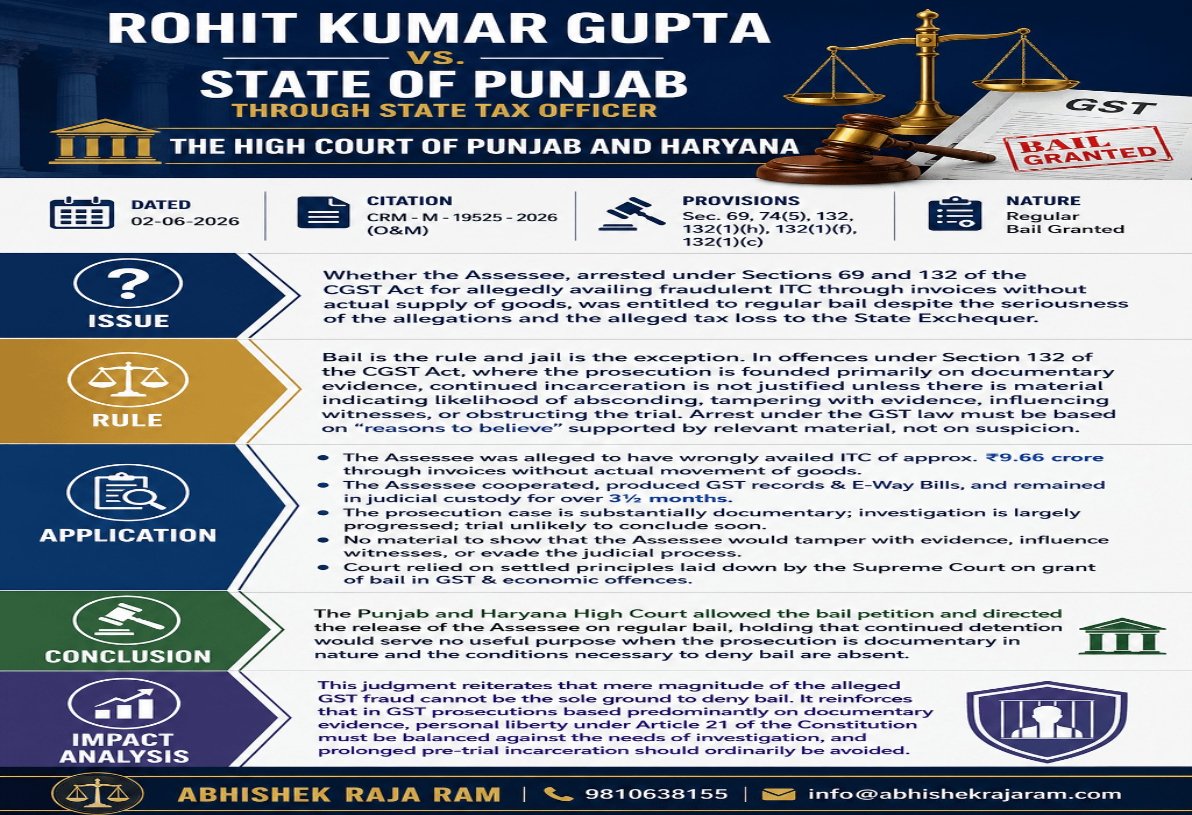
Whether the Assessee, arrested under Sections 69 and 132 of the CGST Act for allegedly availing fraudulent Input Tax Credit through invoices without actual supply of goods, was entitled to regular bail despite the seriousness of the allegations and the alleged tax loss to the State Exchequer.
Rule:
The Court held that bail is the rule and jail is the exception. In offences under Section 132 of the CGST Act, where the prosecution is founded primarily on documentary evidence, continued incarceration is not justified unless there is material indicating that the accused is likely to abscond, tamper with evidence, influence witnesses, or obstruct the trial. The power of arrest under the GST law must be exercised on the basis of "reasons to believe" supported by relevant material and not on mere suspicion.
Application:
The Assessee was arrested after the Department alleged wrongful availment of ITC amounting to approximately ₹9.66 crore through invoices without actual movement of goods. The Assessee had cooperated during the investigation, produced GST records and E-Way Bills, and remained in judicial custody for over three-and-a-half months. The Court observed that the prosecution case was substantially based on documentary evidence, the investigation had largely progressed, the trial was unlikely to conclude soon, and there was no material to show that the Assessee would tamper with evidence, influence witnesses, or evade the judicial process. The Court also relied upon settled principles laid down by the Supreme Court on grant of bail in GST and economic offences.
Conclusion:
The Punjab and Haryana High Court allowed the bail petition and directed the release of the Assessee on regular bail, holding that continued detention would serve no useful purpose when the prosecution was documentary in nature and the conditions necessary to deny bail were absent.
Impact Analysis:
This judgment reiterates that mere magnitude of the alleged GST fraud cannot be the sole ground to deny bail. It reinforces that in GST prosecutions based predominantly on documentary evidence, personal liberty under Article 21 of the Constitution must be balanced against the needs of investigation, and prolonged pre-trial incarceration should ordinarily be avoided.
Title : ROHIT KUMAR GUPTA vs. STATE OF PUNJAB THROUGH STATE TAX OFFICER
Court : THE HIGH COURT OF PUNJAB AND HARYANA
Citation : CRM - M - 19525 - 2026 (O&M)
Dated : 02-06-2026
Provision : Under Section 69, 74(5), 132, 132(1)(h), 132(1)(f), 132(1)(c)


Comments
0 visibleNo approved comments yet. Submit one from the form and it will appear here after admin approval.